
















©The Author(s) 2026.
World J Clin Oncol. Jan 24, 2026; 17(1): 112801
Published online Jan 24, 2026. doi: 10.5306/wjco.v17.i1.112801
Published online Jan 24, 2026. doi: 10.5306/wjco.v17.i1.112801
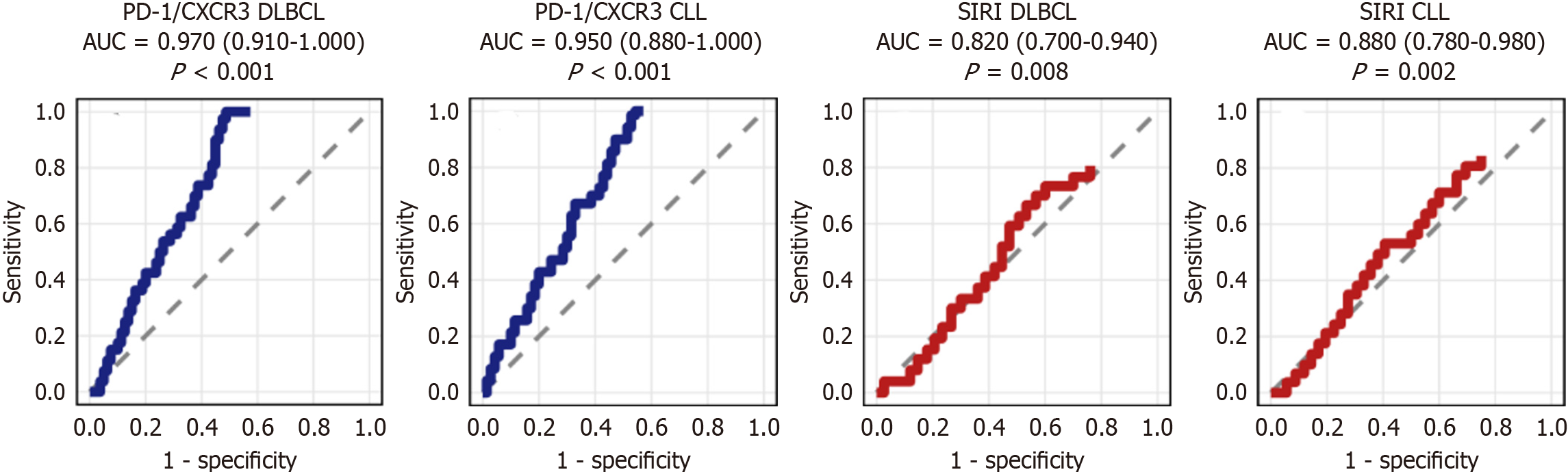
Figure 8 Receiver operating characteristic curves for the diagnosis of stage IV lymphoma stratified by subtype in patients with lymphoproliferative neoplasms (n = 90).
The panels show programmed death-ligand 1/C-X-C motif chemokine receptor 3 (CXCR3) in diffuse large B-cell lymphoma [DLBCL; area under the curve (AUC) = 0.970], programmed cell death protein 1 (PD-1)/CXCR3 in chronic lymphocytic leukemia (CLL) (AUC = 0.950), systemic inflammation response index (SIRI) in DLBCL (AUC = 0.820), and SIRI in CLL (AUC = 0.880). Zigzag stepped lines represent real receiver operating characteristic curves from discrete classification thresholds. Dark blue indicates PD-1/CXCR3; dark red indicates SIRI. All AUCs are statistically significant (P < 0.001 for PD-1/CXCR3, P = 0.008 for SIRI in DLBCL, P = 0.002 for SIRI in CLL). The dashed diagonal line represents chance performance (AUC = 0.5). PD-1: Programmed cell death protein 1; CXCR3: C-X-C motif chemokine receptor 3; DLBCL: Diffuse large B-cell lymphoma; AUC: Area under the curve; CLL: Chronic lymphocytic leukemia; SIRI: Systemic inflammation response index.
- Citation: Sherief DE, Nosair N, Abdelhameed AM, Sadaka E, Othman AAA, Elgamal R. Prognostic significance of PD-L1/PD-1 co-expression and CXCR3-driven inflammatory signatures in Egyptian patients with lymphoproliferative neoplasms. World J Clin Oncol 2026; 17(1): 112801
- URL: https://www.wjgnet.com/2218-4333/full/v17/i1/112801.htm
- DOI: https://dx.doi.org/10.5306/wjco.v17.i1.112801