
















Copyright: ©Author(s) 2026.
World J Biol Chem. Jun 5, 2026; 17(2): 113144
Published online Jun 5, 2026. doi: 10.4331/wjbc.v17.i2.113144
Published online Jun 5, 2026. doi: 10.4331/wjbc.v17.i2.113144
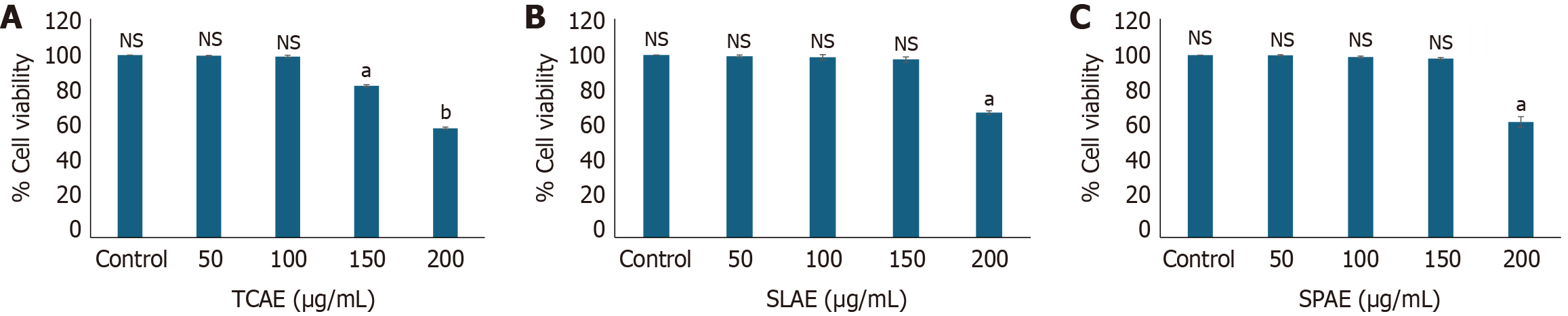
Figure 5 Cell viability in THP-1 cells treated with Tinospora cordifolia stem aqueous extract, Senna siamea leaf aqueous extract and Senna siamea pods aqueous extract.
A: The following graph shows cell viability after treatment with 50-200 μg Tinospora cordifolia stem aqueous extract (TCAE). The highest cell cytotoxicity is found in 200 μg TCAE treatment; B: The following graph shows cell viability after treatment with 50-200 μg Senna siamea leaf aqueous extract (SLAE). The highest cell cytotoxicity was found in the 200 μg SLAE treatment; C: Cell viability in THP-1 cells treated with Senna siamea pods aqueous extract (SPAE). The following graph shows the cell viability after treatment with SPAE of concentration ranging 50-200 μg. The highest cell cytotoxicity is found in TCAE treatment with 200 μg concentration. aP < 0.05 vs control group; bP < 0.01 vs control group; NS indicates not significant. TCAE: Tinospora cordifolia stem aqueous extract; SLAE: Senna siamea leaf aqueous extract; SPAE: Senna siamea pods aqueous extract.
- Citation: Boro A, Jothi Dheivasikamani A, Prabhu Jeyabal Philomenathan A, Manivannan J, Krishnaswamy S, Palanisamy S, Arumugam VA. Study of Tinospora cordifolia stem and Senna siamea leaf and pods: An in vitro therapeutic approach for leukemia. World J Biol Chem 2026; 17(2): 113144
- URL: https://www.wjgnet.com/1949-8454/full/v17/i2/113144.htm
- DOI: https://dx.doi.org/10.4331/wjbc.v17.i2.113144