
















©The Author(s) 2025.
World J Biol Chem. Dec 5, 2025; 16(4): 111110
Published online Dec 5, 2025. doi: 10.4331/wjbc.v16.i4.111110
Published online Dec 5, 2025. doi: 10.4331/wjbc.v16.i4.111110
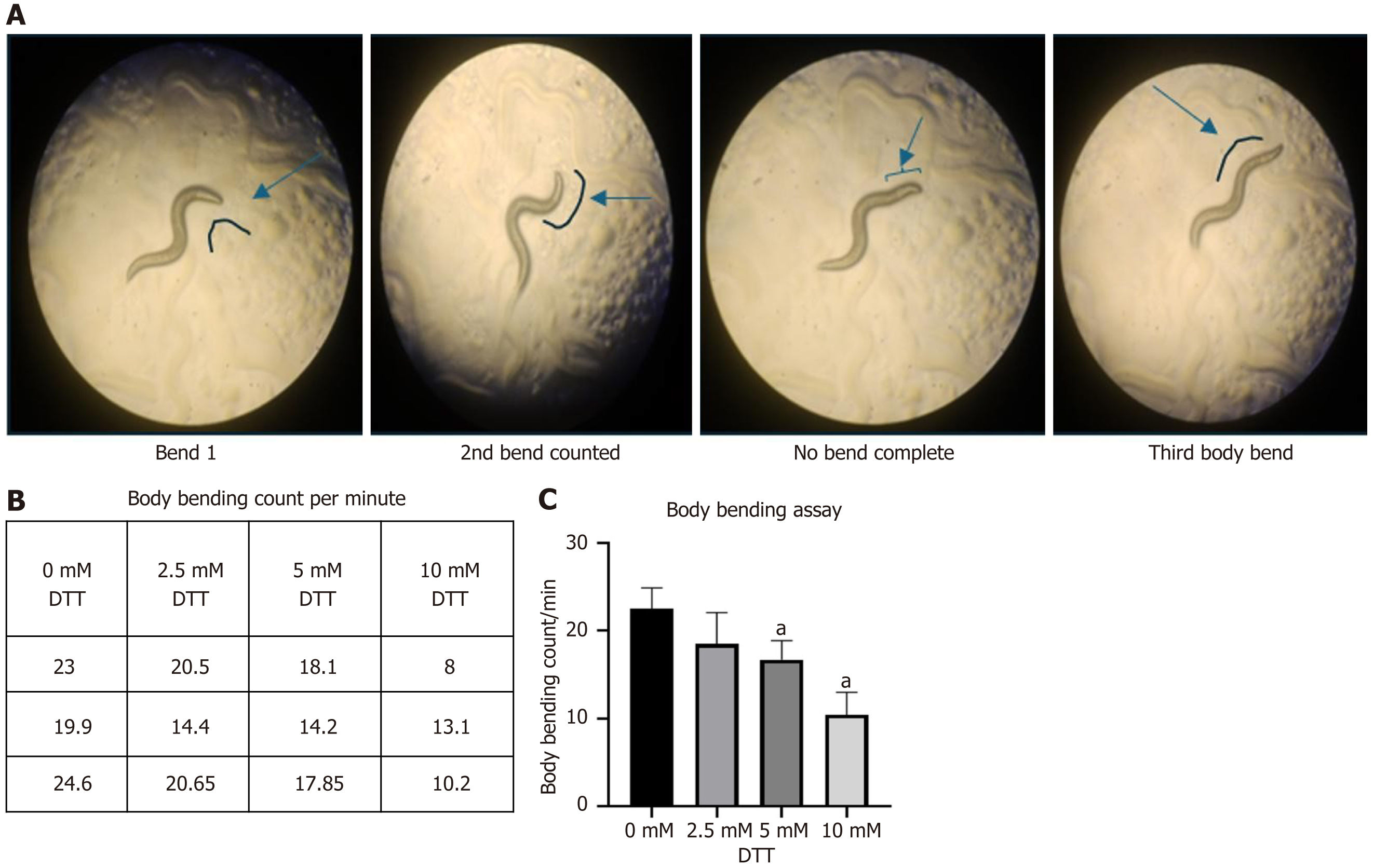
Figure 2 Body bending assay.
A: Counting criteria of body bend in Caenorhabditis elegans. From the left side, complete bends are seen in frames 1st, 2nd, and last and image 3rd show an incomplete bend; B: Average Body bend count per minute at 0-10 mmol/L dithiothreitol (DTT) concentration; C: The body bend graph indicates a declining count where animals were exposed to increasing concentrations of DTT (0–10 mmol/L). Data are presented as mean ± SEM (n = 3). Statistical analysis was performed using the Kruskal-Wallis test. aP < 0.01 vs control (0 mmol/L DTT). DTT: Dithiothreitol.
- Citation: Raj G, Kumar M, Shreya S, Bhardwaj S, Priya R, Mangalhara KC, Jain BP. Dithiothreitol induced endoplasmic reticulum stress and its role in neurodegeneration in Caenorhabditis elegans. World J Biol Chem 2025; 16(4): 111110
- URL: https://www.wjgnet.com/1949-8454/full/v16/i4/111110.htm
- DOI: https://dx.doi.org/10.4331/wjbc.v16.i4.111110