
















Copyright: ©Author(s) 2026.
World J Gastrointest Surg. Aug 27, 2026; 18(8): 121285
Published online Aug 27, 2026. doi: 10.4240/wjgs.121285
Published online Aug 27, 2026. doi: 10.4240/wjgs.121285
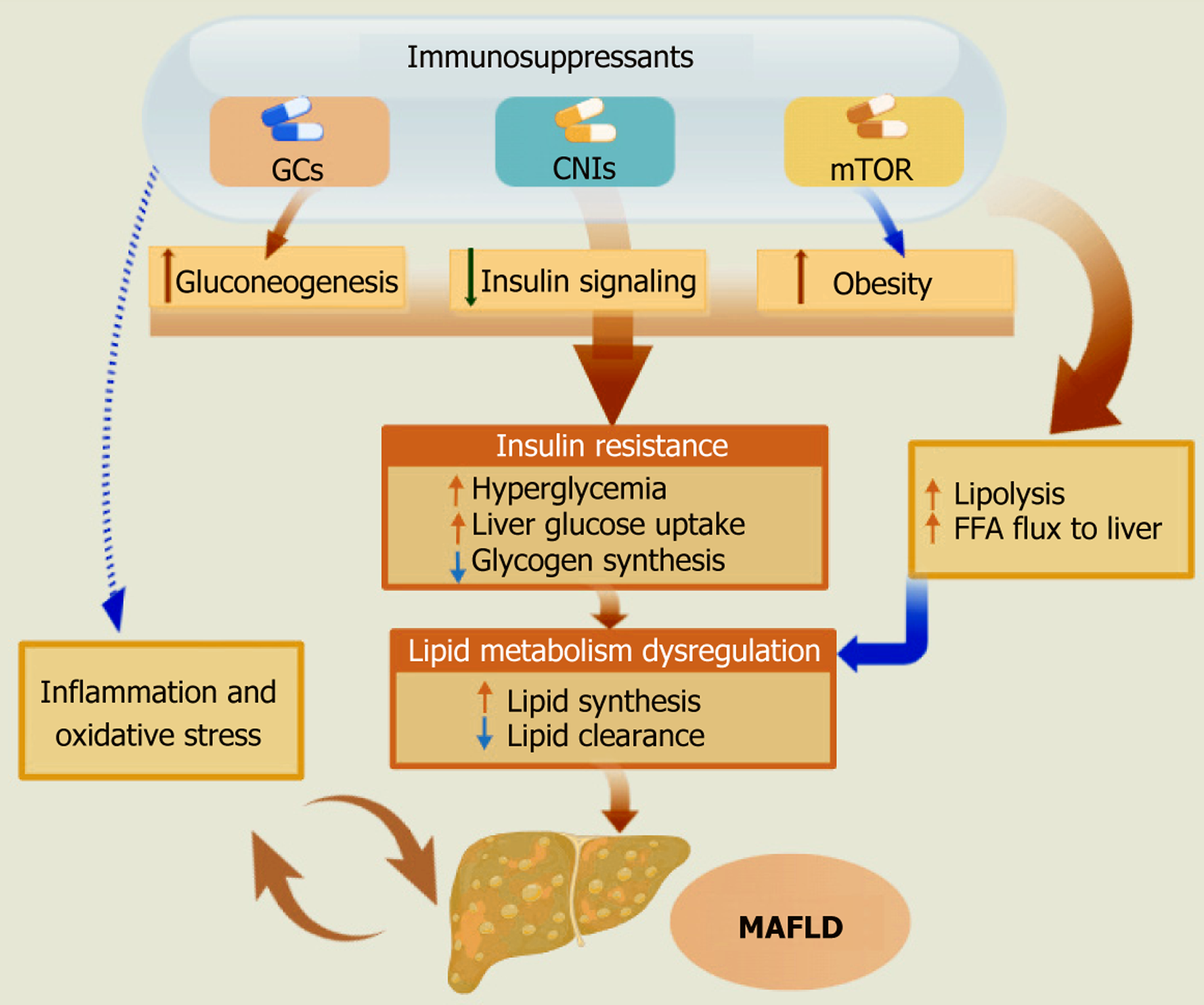
Figure 1 Mechanistic interplay between immunosuppression and post-transplant metabolic dysfunction-associated fatty liver disease.
This schematic illustrates how immunosuppressive agents drive metabolic dysfunction-associated fatty liver disease following transplantation. Glucocorticoids stimulate hepatic gluconeogenesis, calcineurin inhibitors impair insulin signaling, and mammalian target of rapamycin inhibitors often exacerbate adiposity. These pathways converge to induce insulin resistance (IR), characterized by systemic hyperglycemia and defective hepatic glucose metabolism. Central to this pathology, IR triggers adipose tissue lipolysis, increasing free fatty acid flux to the liver. This influx, coupled with dysfunctional insulin signaling, promotes de novo lipogenesis while suppressing lipid clearance. Concurrently, immunosuppressant-induced oxidative stress and inflammatory signaling amplify hepatocellular injury. These interconnected mechanisms form a pro-steatotic feedback loop, positioning IR as the primary hub linking clinical therapy to metabolic dysfunction-associated fatty liver disease progression and identifying IR as a critical target for metabolic intervention. GCs: Glucocorticoids; CNIs: Calcineurin inhibitors; mTOR: Mammalian target of rapamycin; FFA: Free fatty acid; MAFLD: Metabolic dysfunction-associated fatty liver disease.
- Citation: Liu JR, Zhao L, Niu QH, Cai JZ, Liu HY. Mechanisms and treatment of metabolic dysfunction-associated fatty liver disease after liver transplantation. World J Gastrointest Surg 2026; 18(8): 121285
- URL: https://www.wjgnet.com/1948-9366/full/v18/i8/121285.htm
- DOI: https://dx.doi.org/10.4240/wjgs.121285