
















Copyright: ©Author(s) 2026.
World J Gastrointest Surg. Nov 27, 2026; 18(11): 123786
Published online Nov 27, 2026. doi: 10.4240/wjgs.123786
Published online Nov 27, 2026. doi: 10.4240/wjgs.123786
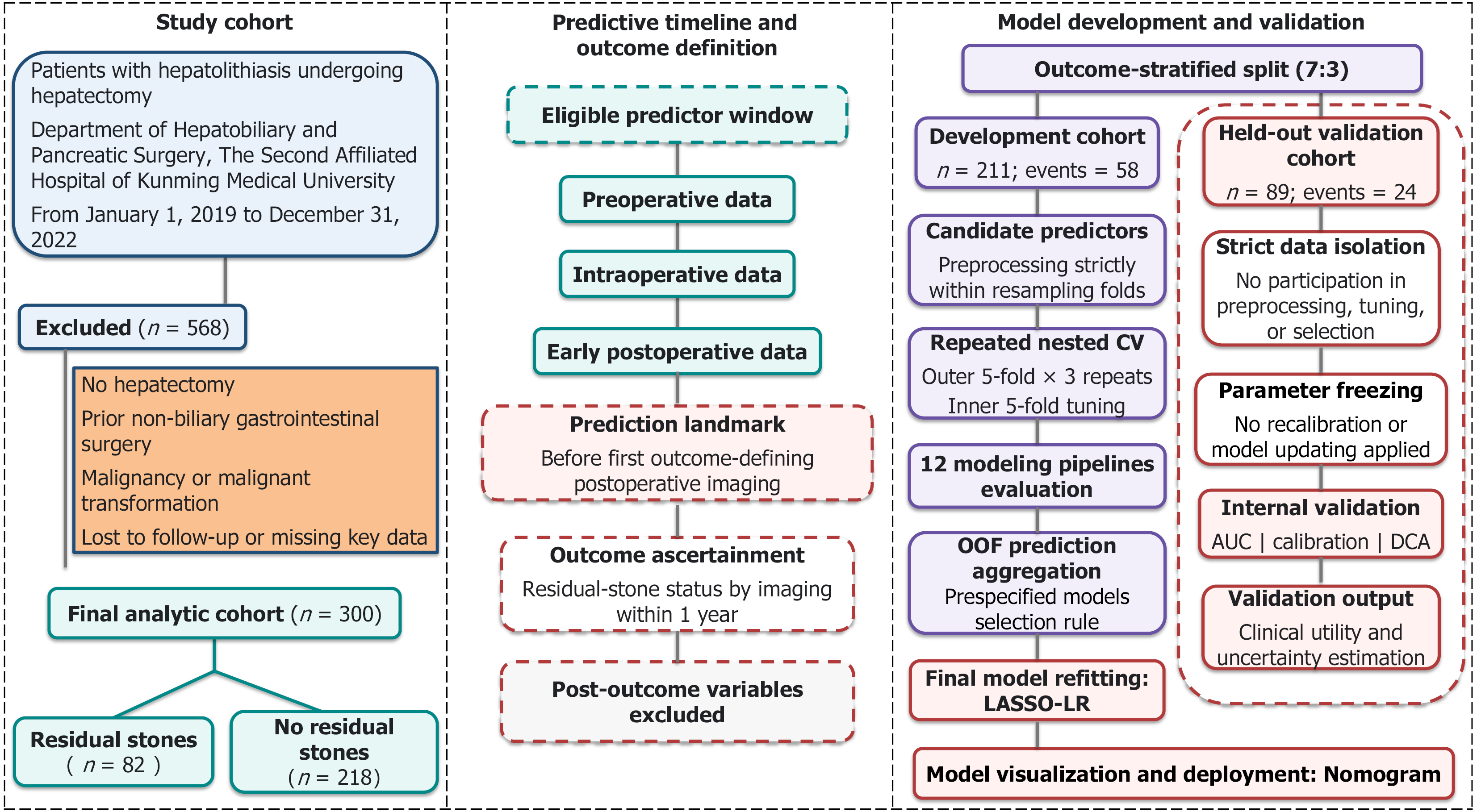
Figure 1 Study population, predictive timeline, and zero-leakage model development workflow.
The flow chart illustrates the selection process for the final analytic cohort (n = 300) from hepatolithiasis patients undergoing hepatectomy. The predictive timeline defines the eligible predictor window prior to the prediction landmark (first postoperative imaging) to prevent look-ahead bias. The methodological framework summarizes the steps for model development and internal validation. An outcome-stratified split (7:3) yielded a development cohort (n = 211; 58 events) and a held-out validation cohort (n = 89; 24 events). Candidate predictors were evaluated across 12 candidate modeling pipelines using repeated nested cross-validation (5-fold × 3 repeats) within the development cohort. The locked least absolute shrinkage and selection operator-logistic regression model was refit on the full development cohort and subsequently evaluated once in the strictly isolated validation cohort. AUC: Area under the receiver operating characteristic curve; CV: Cross-validation; DCA: Decision curve analysis; LASSO-LR: Least absolute shrinkage and selection operator-logistic regression.
- Citation: Shao HR, Zeng D, Chen X, Zhu Y, Liu LX, Zhao SL, Zou H. Development and validation of a postoperative prediction model for residual stones after hepatectomy in patients with hepatolithiasis. World J Gastrointest Surg 2026; 18(11): 123786
- URL: https://www.wjgnet.com/1948-9366/full/v18/i11/123786.htm
- DOI: https://dx.doi.org/10.4240/wjgs.123786