
















©The Author(s) 2026.
World J Gastrointest Surg. Jan 27, 2026; 18(1): 112988
Published online Jan 27, 2026. doi: 10.4240/wjgs.v18.i1.112988
Published online Jan 27, 2026. doi: 10.4240/wjgs.v18.i1.112988
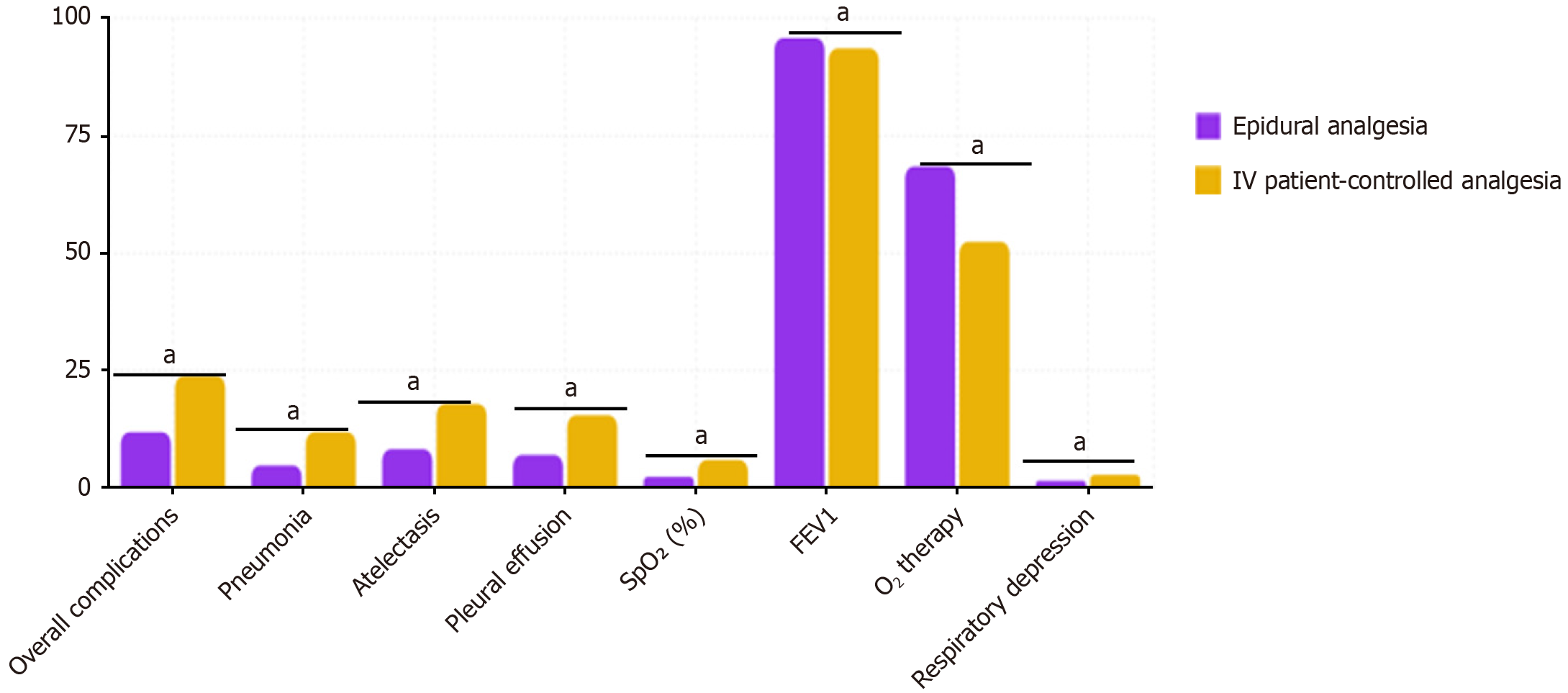
Figure 1 Pulmonary complications.
Significantly lower rates across all categories for the epidural anesthesia group compared to the intravenous patient-controlled analgesia group: Overall complications: 11.9% vs 23.8% (aP = 0.042); pneumonia: 4.8% vs 11.9% (aP = 0.038); Atelectasis: 8.3% vs 17.9% (aP = 0.022); pleural effusion: 7.1% vs 15.5% (aP = 0.046); respiratory function parameters. Better outcomes in the epidural anesthesia group: Higher SpO2 levels: 95.8% vs 93.6% (aP < 0.001); better forced expiratory volume in 1 second values: 68.5% vs 52.4% of preoperative values (aP < 0.001); shorter supplemental oxygen therapy: 1.6 days vs 2.8 days (aP < 0.001); lower respiratory depression rates: 2.4% vs 6.0% (aP = 0.246, not statistically significant). EA: Epidural anesthesia; IVPCA: Intravenous patient-controlled analgesia; FEV1: Forced expiratory volume in 1 second.
- Citation: Li PP, Qu Q, Shao CH. Comparison of epidural anesthesia and intravenous self-control analgesia on postoperative recovery quality in duodenectomy. World J Gastrointest Surg 2026; 18(1): 112988
- URL: https://www.wjgnet.com/1948-9366/full/v18/i1/112988.htm
- DOI: https://dx.doi.org/10.4240/wjgs.v18.i1.112988