










BPG is committed to discovery and dissemination of knowledge
Letter to the Editor
©The Author(s) 2025.
World J Gastrointest Surg. Nov 27, 2025; 17(11): 112124
Published online Nov 27, 2025. doi: 10.4240/wjgs.v17.i11.112124
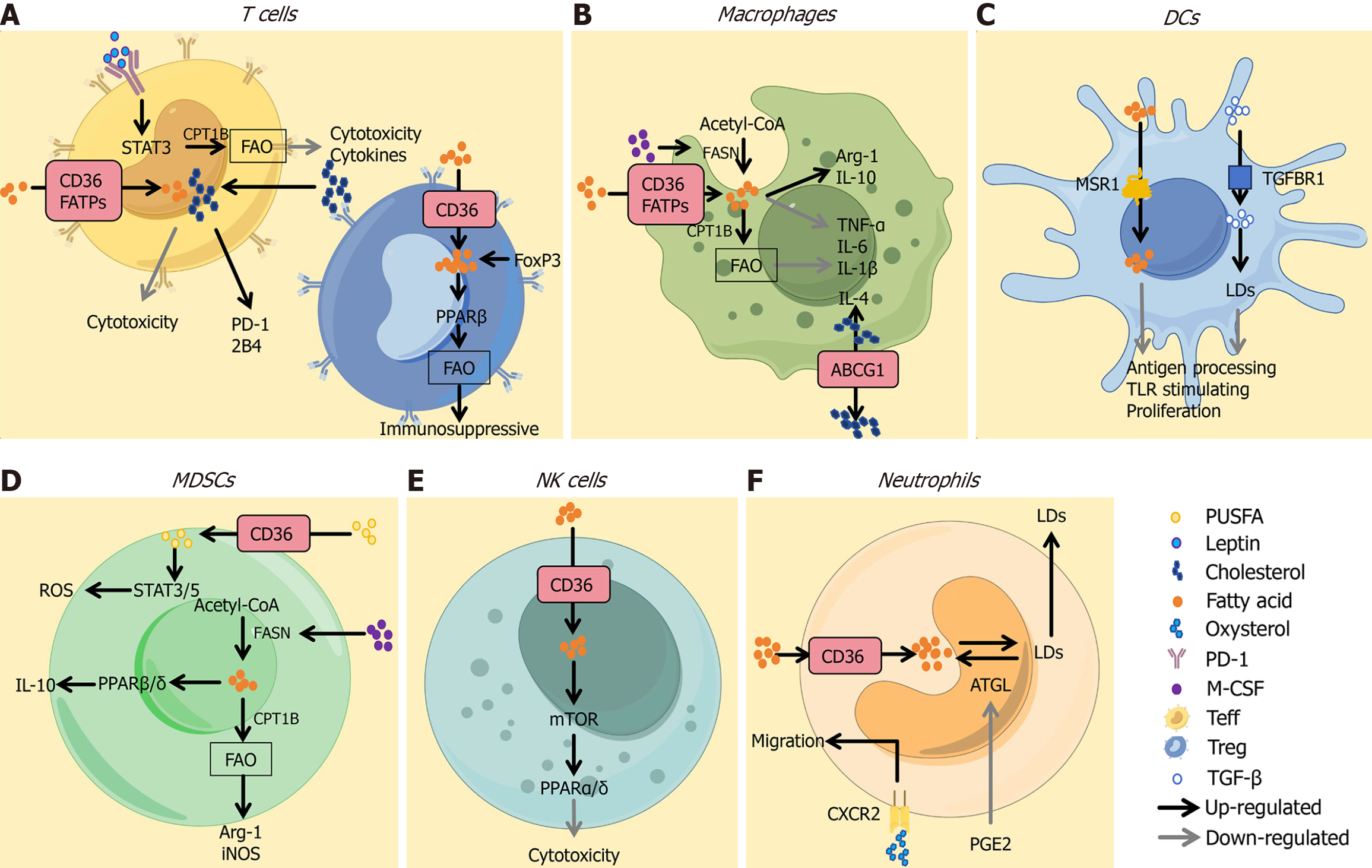
Figure 2
Figure 2 Lipid metabolism in pro-tumor immune responses[3]. A: Fatty acids (FAs) taken up via CD36 or FA transport proteins mediate immunosuppression by inducing effector T cell (Teff) exhaustion or stimulating PPAR-β and FA oxidation (FAO) in regulatory T cells (Tregs). FoxP3 regulates FA metabolism in Tregs to exert immunosuppressive effects. Cholesterol induces programmed cell death protein 1 (PD-1) and 2B-4 expression, promoting Teff exhaustion to drive tumor growth. Leptin in the tumor microenvironment (TME) suppresses Teff via the PD-1-STAT3-CPT1B pathway, enhancing FAO and reducing cytotoxicity; B: In macrophages, FAs taken up via transporters or synthesized de novo stimulate CPT1B and FAO, enhancing secretion of immunosuppressive cytokines [e.g., arginase 1 (ARG-1), interleukin (IL)-10] or suppressing pro-inflammatory cytokines (e.g., tumor necrosis factor-α, IL-6, IL-1β). Macrophage colony-stimulating factor (M-CSF) from the TME upregulates FA synthase (FASN) expression. Macrophages with high ABCG1 expression transport cholesterol out, promoting IL-4 secretion and tumor progression; C: MSR1 and TGFBR1 facilitate FA transport and lipid droplet (LD) formation in dendritic cells (DCs), influencing antigen processing, Toll-like receptor stimulation, and DC proliferation; D: CD36 on myeloid-derived suppressor cells (MDSCs) mediates uptake of polyunsaturated FAs, activating STAT3/5 and inducing reactive oxygen species production. M-CSF promotes FASN and FA production in MDSCs, enhancing secretion of immunosuppressive cytokines (e.g., IL-10, ARG-1, inducible nitric oxide synthase); E: FAs suppress natural killer cell cytotoxicity via the mTOR (mechanistic target of rapamycin)-PPAR signaling pathway; F: Neutrophils accumulate LDs due to elevated exogenous FA uptake and downregulated adipose triglyceride lipase by PGE2. LDs in neutrophils are transported to tumor cells to promote proliferation. Oxysterol enhances neutrophil migration by binding to CXCR2. Citation: Yu W, Lei Q, Yang L, Qin G, Liu S, Wang D, Ping Y, Zhang Y. Contradictory roles of lipid metabolism in immune response within the tumor microenvironment. J Hematol Oncol 2021; 14: 187. Copyright ©The Author(s) 2021. Published by Biomed Central (Supplementary material). M-CSF: Macrophage colony-stimulating factor; NK: Natural killer; PD-1: Programmed cell death protein 1; DC: Dendritic cell; MDSC: Myeloid-derived suppressor cell; ROS: Reactive oxygen species.


Write to the Help Desk