
















©The Author(s) 2025.
World J Gastrointest Surg. Oct 27, 2025; 17(10): 111290
Published online Oct 27, 2025. doi: 10.4240/wjgs.v17.i10.111290
Published online Oct 27, 2025. doi: 10.4240/wjgs.v17.i10.111290
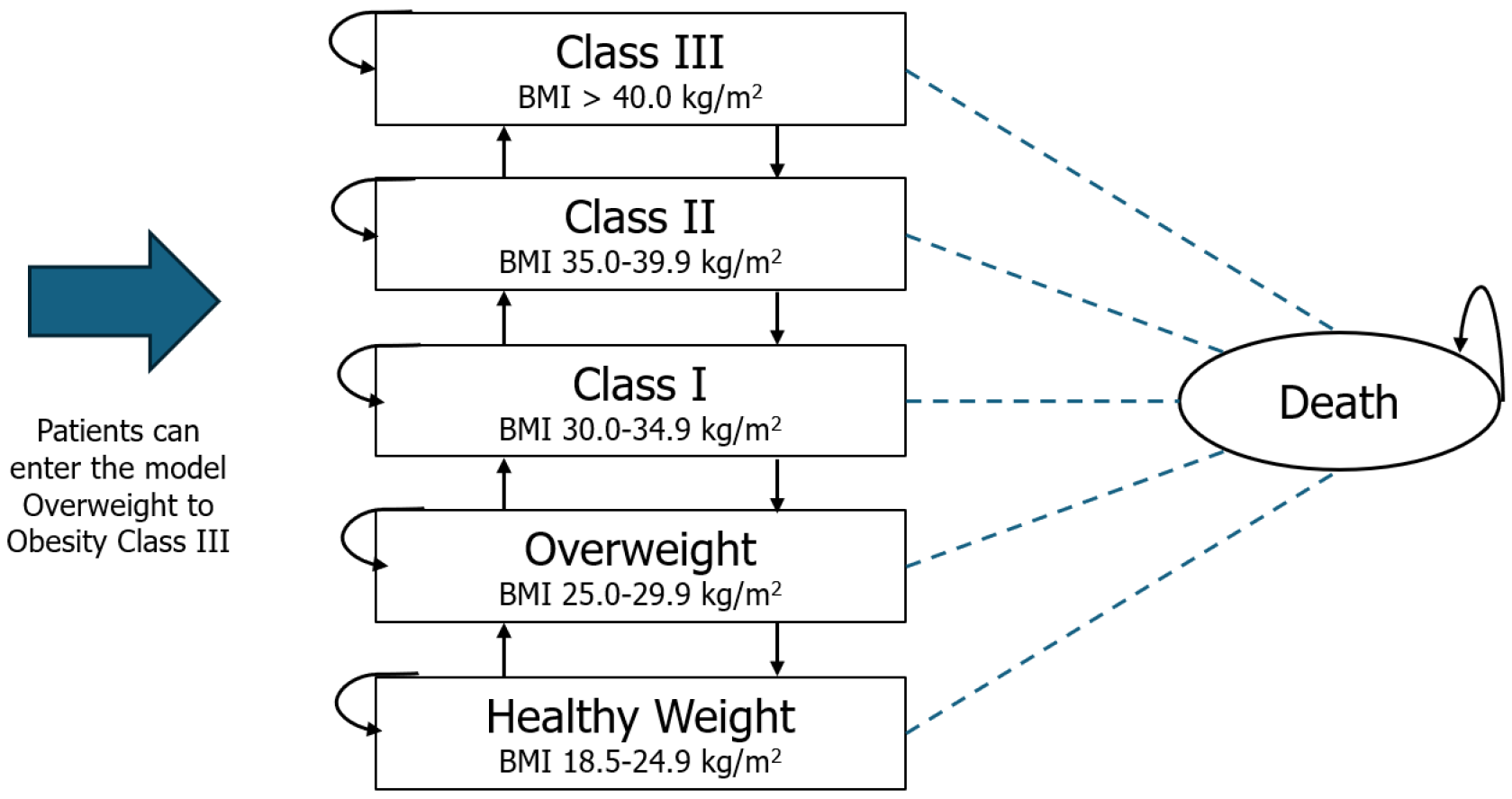
Figure 1 Model schematic.
Patients enter the model in one of five body mass index (BMI)-group health states: Healthy weight, overweight, and class I-III obesity. Patients in the overweight to class III obesity health states receive either endoscopic sleeve gastroplasty + lifestyle modification or lifestyle modification alone. Patients cycle between health states (e.g., from overweight to class I, or from class III to class II) based on transition probabilities from real-world data, established BMI-group associated mortality risks and key opinion leader opinion, as included in the model. Patients could also move from any of the 5 BMI group-based health states to an absorbing (i.e., irreversible) mortality death state and would not be able to re-enter another state during a future cycle. Cycle length is set at twice yearly for the first year, and then yearly through 5 years in the base-case. Patients can move states each cycle. BMI: Body mass index.
- Citation: Donnangelo L, Gadi SRV, Maselli D, Oneill F, Wooley C, Casey S, McGowan CE. Endoscopic sleeve gastroplasty vs lifestyle modification for weight loss: A real-world cost-effectiveness study. World J Gastrointest Surg 2025; 17(10): 111290
- URL: https://www.wjgnet.com/1948-9366/full/v17/i10/111290.htm
- DOI: https://dx.doi.org/10.4240/wjgs.v17.i10.111290