
















©The Author(s) 2025.
World J Gastrointest Surg. Oct 27, 2025; 17(10): 109260
Published online Oct 27, 2025. doi: 10.4240/wjgs.v17.i10.109260
Published online Oct 27, 2025. doi: 10.4240/wjgs.v17.i10.109260
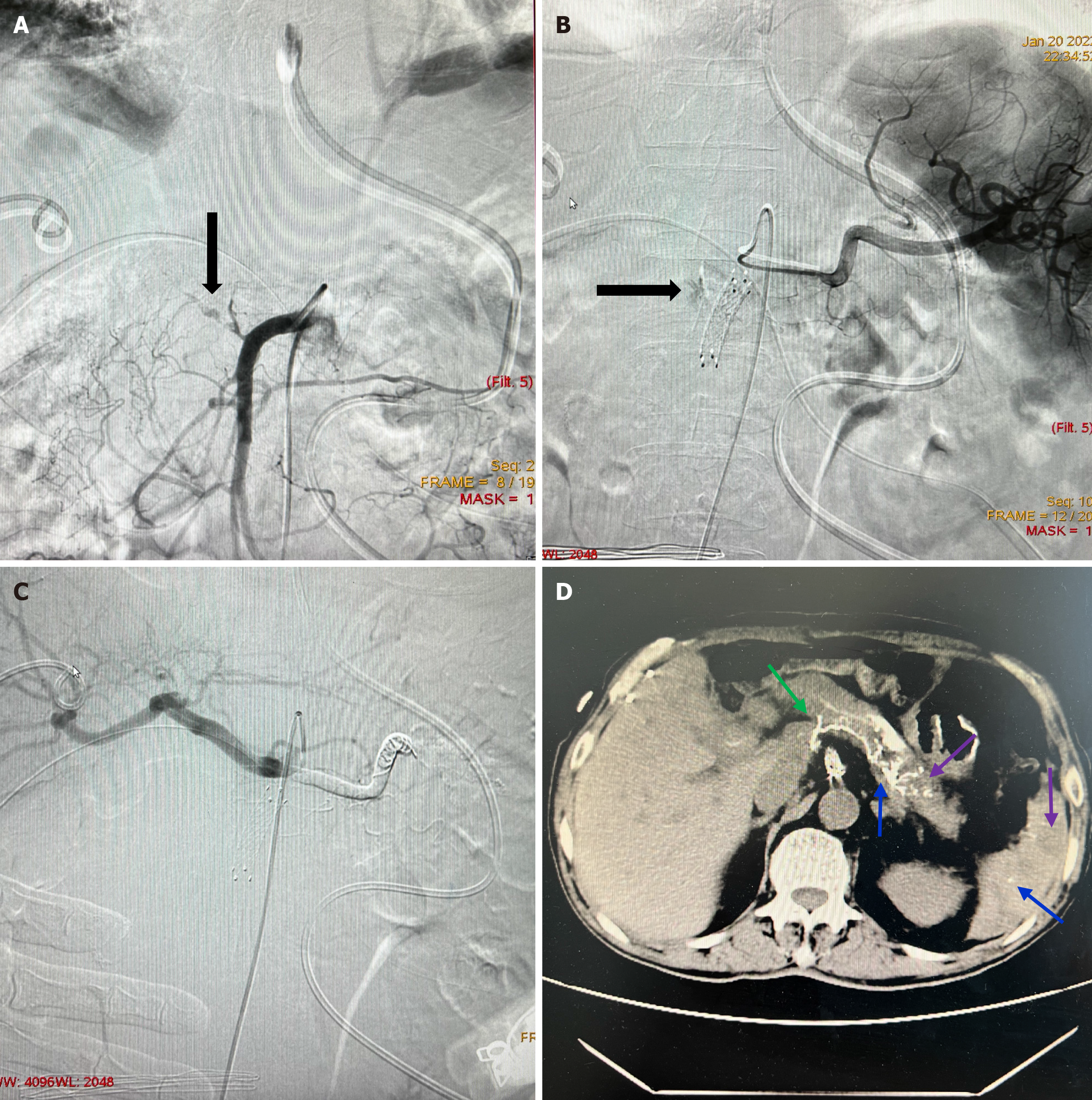
Figure 3 Hemorrhage occurring 19 days after pancreaticoduodenectomy for cholangiocarcinoma in a 68-year-old male patient.
A: Superior mesenteric artery angiography was performed, and extravasation of the contrast agent (black down arrow) was detected. Subsequently, covered stent implantation was performed; B: The patient experienced rebleeding 5 days after the initial endovascular treatment. Splenic artery angiography was performed, and extravasation of the contrast agent (black right arrow) was detected. Because of the tortuous origin of the splenic and bleeding arteries, superselective arterial embolization and covered stent implantation could not be performed successfully; C: Coil-assisted N-butyl cyanoacrylate (NBCA) embolization was performed successfully; D: NBCA deposits in the targeted bleeding lesion (green arrow) and target- and non-target-organ embolization (blue arrow) were observed in the subsequent imagological examination. Pancreatic and splenic small partial low-density regions (purple arrow) were asymptomatic and self-limited. The patient did not experience rebleeding.
- Citation: He CJ, Wang XD, Ge NJ, Liu X, Huang J, Xu W, Ni CF, Yang YF. Coil-assisted N-butyl cyanoacrylate embolization vs covered stent implantation for delayed hemorrhage in hepatobiliary and pancreatic surgery. World J Gastrointest Surg 2025; 17(10): 109260
- URL: https://www.wjgnet.com/1948-9366/full/v17/i10/109260.htm
- DOI: https://dx.doi.org/10.4240/wjgs.v17.i10.109260