
















Copyright: ©Author(s) 2026.
World J Diabetes. May 15, 2026; 17(5): 118275
Published online May 15, 2026. doi: 10.4239/wjd.v17.i5.118275
Published online May 15, 2026. doi: 10.4239/wjd.v17.i5.118275
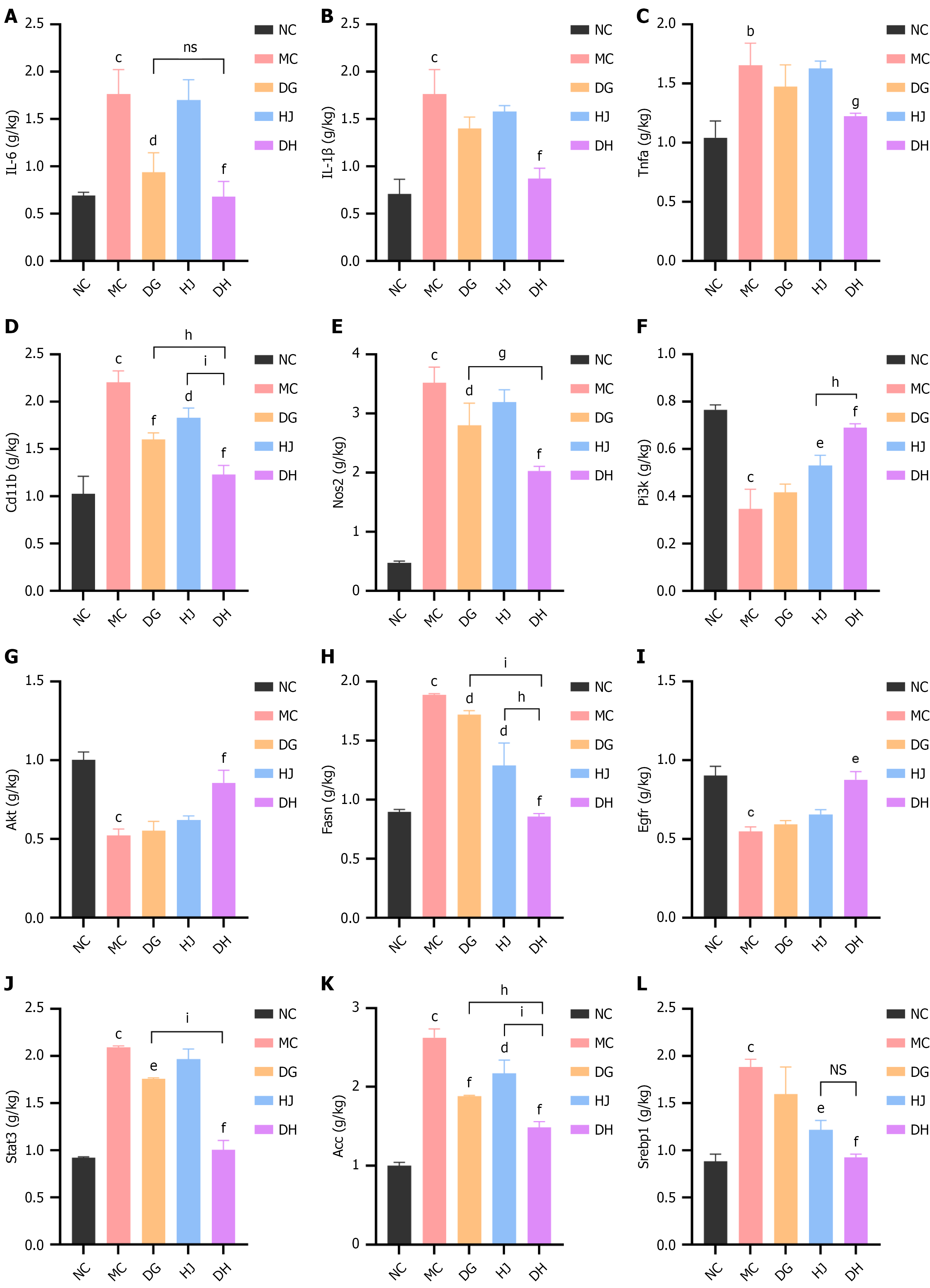
Figure 8 Danggui-Huangjing robustly reduces the expression of inflammation and lipogenesis-related genes in obese C57BL/6 mice.
A: Relative hepatic mRNA expression of IL6; B: Relative hepatic mRNA expression of IL1b; C: Relative hepatic mRNA expression of Tnfa; D: Relative hepatic mRNA expression of Cd11b; E: Relative hepatic mRNA expression of Nos2; F: Relative hepatic mRNA expression of Pi3k; G: Relative hepatic mRNA expression of Akt; H: Relative hepatic mRNA expression of Fasn; I: Relative hepatic mRNA expression of Egfr; J: Relative hepatic mRNA expression of Stat3; K: Relative hepatic mRNA expression of Acc; L: Relative hepatic mRNA expression of Srebp1. RNA extraction (AG21017 kit), complementary DNA synthesis (AG11728 kit), qPCR (StepOne Plus system, SYBR Green kit AG11739); β-Actin as internal reference, relative expression via 2-ΔΔCt method. Data are presented as mean ± SD and were analyzed by one-way analysis of variance followed by the Bonferroni post hoc test (n = 6/group). aP < 0.05, bP < 0.01, cP < 0.001 vs normal control group; dP < 0.05, eP < 0.01, fP < 0.001 vs model control group; gP < 0.05, hP < 0.01, iP < 0.001 vs Danggui-Huangjing group. NS: Not significant (for Danggui-Huangjing vs Danggui/Huangjing groups, no statistical difference). DG: Danggui; DH: Danggui-Huangjing; HJ: Huangjing; MC: Model control; NC: Normal control.
- Citation: Li WJ, Xu JJ, Tiang HS, Liu TH, Wu LL. Network pharmacology: Anti-obesity and insulin-sensitizing effects of Danggui-Huangjing herb-pair via epidermal growth factor receptor/phosphatidylinositol 3-kinase/protein kinase B pathway. World J Diabetes 2026; 17(5): 118275
- URL: https://www.wjgnet.com/1948-9358/full/v17/i5/118275.htm
- DOI: https://dx.doi.org/10.4239/wjd.v17.i5.118275