
















©The Author(s) 2025.
World J Diabetes. Nov 15, 2025; 16(11): 112236
Published online Nov 15, 2025. doi: 10.4239/wjd.v16.i11.112236
Published online Nov 15, 2025. doi: 10.4239/wjd.v16.i11.112236
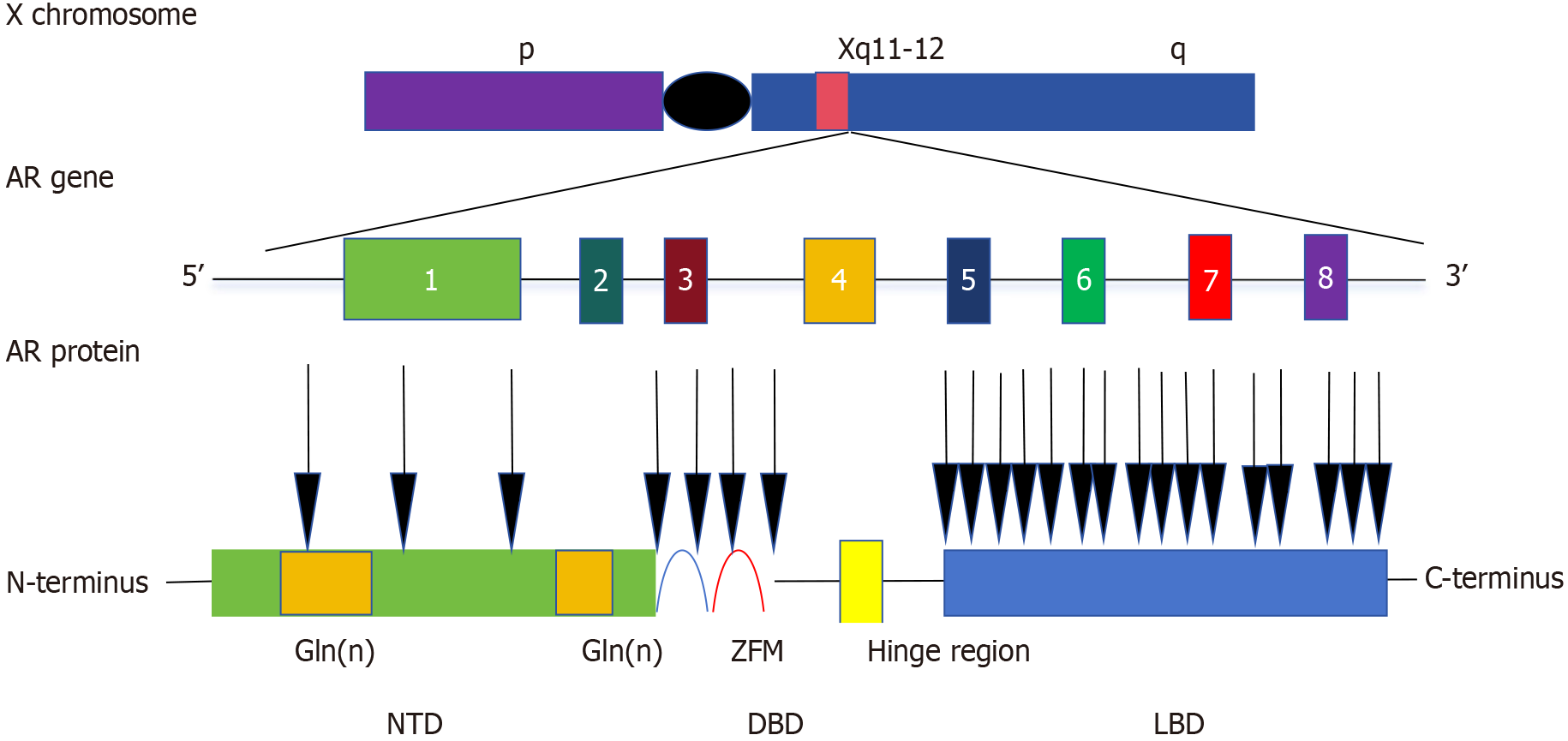
Figure 1 Genomic location of the androgen receptor gene on the X chromosome and schematic structure of the encoded protein.
The upper panel shows the short (p) and long (q) arms of the X chromosome, with the androgen receptor (AR) gene located at Xq11-12. The middle panel illustrates the 5'→3'orientation of the AR gene, which contains eight exons (colored boxes). Exon 1 encodes the N-terminal transactivation domain (NTD), whereas exons 2-3 and 4-8 encode the DNA-binding domain (including zinc finger motifs) and ligand-binding domain (LBD), respectively. The lower panel displays the major structural domains of the AR protein: The NTD, which contains two polymorphic polyglutamine glutamine tracts; the DNA-binding domain, comprising two zinc fingers and a hinge region; and the LBD located at the C-terminus. Black arrows indicate the distribution of mutation sites identified in this study, which are predominantly clustered in the NTD and LBD. AR: Androgen receptor; NTD: N-terminal transactivation domain; DBD: DNA-binding domain; LBD: Ligand-binding domain; Gln: Glutamine; ZFM: Zinc finger motif; Gln(n): Glutamine (n repeats).
- Citation: Luo C, Zhang WW, Hua LY, Zeng MQ, Xu H, Duan CZ, Xu SY, Zhan S, Pan XF, Sun D, Ye LY, He DJ. Androgen receptor mutations in familial androgen insensitivity syndrome: A metabolic reprogramming pathway to type 2 diabetes susceptibility. World J Diabetes 2025; 16(11): 112236
- URL: https://www.wjgnet.com/1948-9358/full/v16/i11/112236.htm
- DOI: https://dx.doi.org/10.4239/wjd.v16.i11.112236