
















©The Author(s) 2025.
World J Diabetes. Nov 15, 2025; 16(11): 109859
Published online Nov 15, 2025. doi: 10.4239/wjd.v16.i11.109859
Published online Nov 15, 2025. doi: 10.4239/wjd.v16.i11.109859
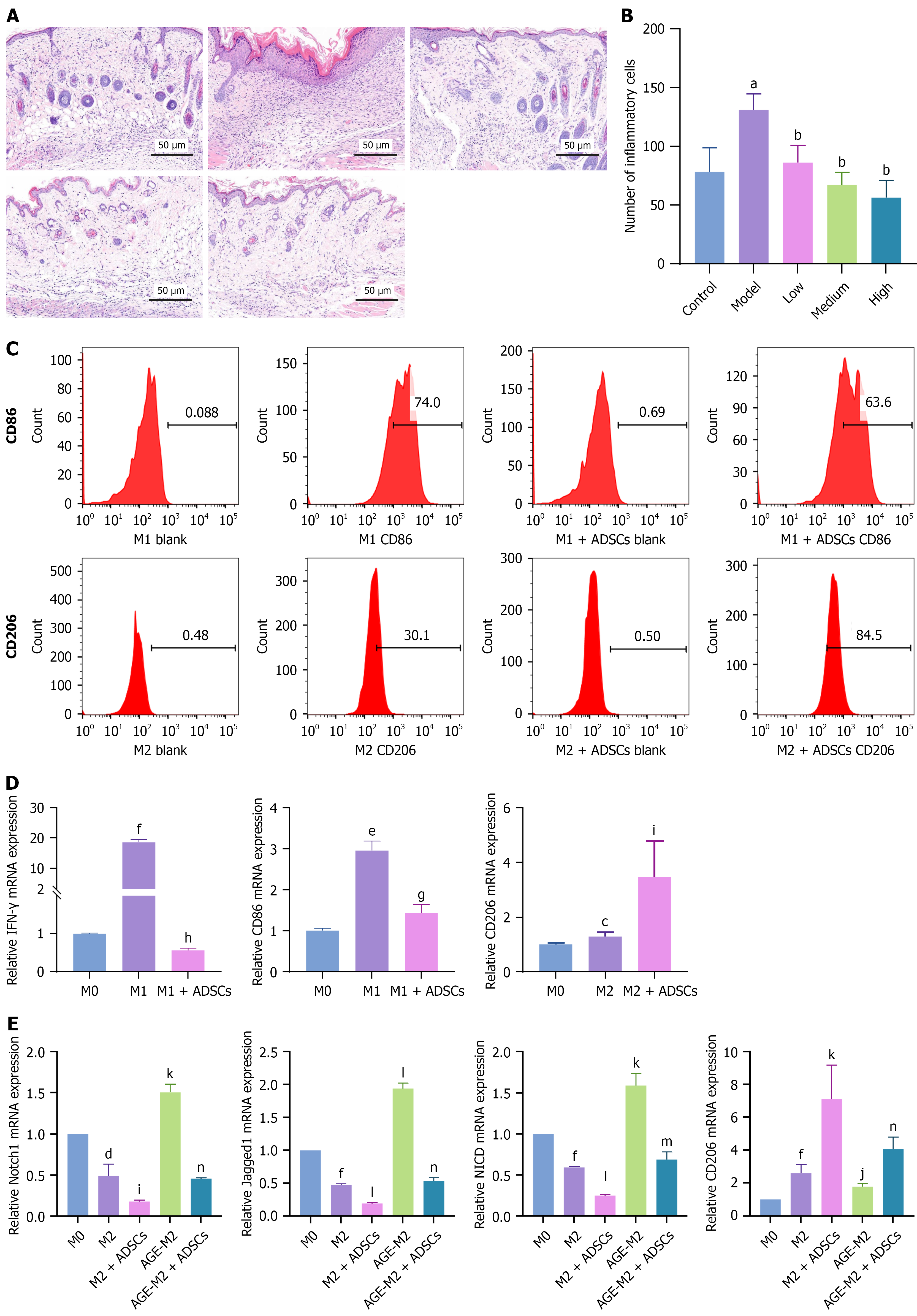
Figure 5 Immunomodulation of adipose-derived mesenchymal stem cells in diabetic foot ulcer mouse model and THP-1-derived macrophages.
A and B: Hematoxylin and eosin staining revealed a significant decrease in inflammatory infiltrating cells on day 7 after subcutaneous adipose-derived mesenchymal stem cell (ADSC) administration to the mice, n = 7; C: Flow cytometry revealed that coculture with ADSCs reduced the proportion of CD86-positive M1 macrophages and increased the proportion of CD206-positive M2 macrophages; D: Reverse transcription-quantitative polymerase chain reaction demonstrated that ADSCs promoted CD206 expression while inhibiting CD86 and interferon-γ gene expression; E: Reverse transcription-quantitative polymerase chain reaction showed that advanced glycation end products treatment led to Notch1, Jagged1, and Notch intracellular domain overexpression while inhibiting CD206 expression. However, ADSCs adjusted the excessive activation of key genes in the Notch1 signaling pathway and restored CD206 expression. M1 and M2 represent M0 cells stimulated with M1 or M2 polarization factors, respectively. M1 blank indicates M1 cells incubated with the isotype antibody. M1 CD86 represents M1 cells that were incubated with the anti-CD86 antibody. M1 + ADSCs CD86 indicates M1 cells cocultured with ADSCs and then incubated with an anti-CD86 antibody. The grouping method for M2 is the same as that for M1. The data are presented as mean ± SD. Scale bar, 50 μm. ADSC: Adipose-derived mesenchymal stem cell; IFN-γ: Interferon; AGE: Advanced glycation end products; NICD: Notch intracellular domain. aP < 0.0001 vs control, bP < 0.0001 vs model, cP < 0.05 vs M0, dP < 0.01 vs M0, eP < 0.001 vs M0, fP < 0.0001 vs M0, gP < 0.01 vs M1, hP < 0.0001 vs M1, iP < 0.05 vs M2, jP < 0.01 vs M2, kP < 0.001 vs M2, lP < 0.0001 vs M2, mP < 0.001 vs advanced glycation end products-M2, and nP < 0.0001 vs advanced glycation end products-M2.
- Citation: Cao J, Liu ZC, An WQ, Zhang S, Zhang X, Li LJ, Ji HL, Long X, Yang YM. Optimizing adipose-derived stem cell therapy for diabetic foot ulcers. World J Diabetes 2025; 16(11): 109859
- URL: https://www.wjgnet.com/1948-9358/full/v16/i11/109859.htm
- DOI: https://dx.doi.org/10.4239/wjd.v16.i11.109859