
















©The Author(s) 2025.
World J Diabetes. Oct 15, 2025; 16(10): 111813
Published online Oct 15, 2025. doi: 10.4239/wjd.v16.i10.111813
Published online Oct 15, 2025. doi: 10.4239/wjd.v16.i10.111813
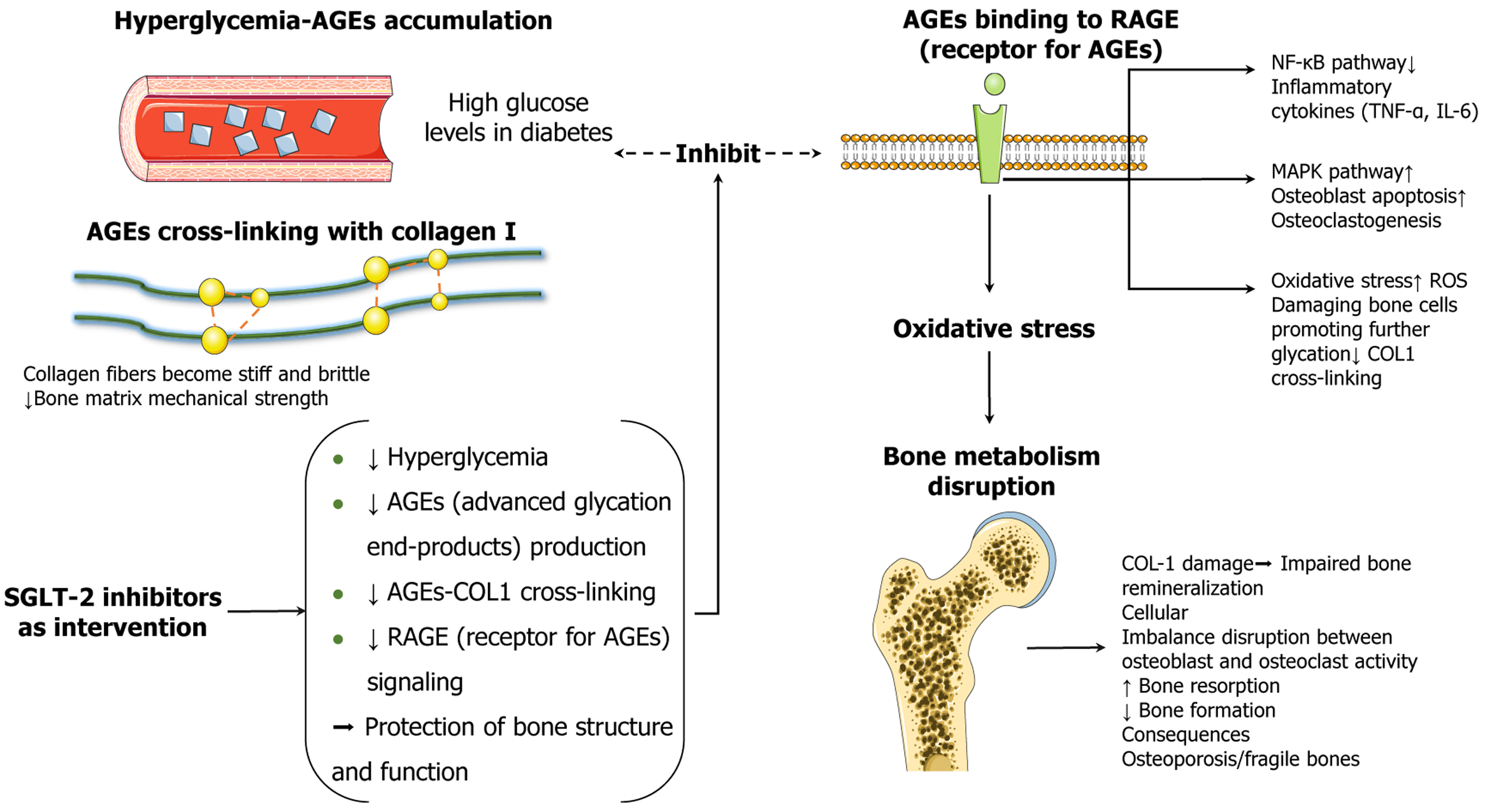
Figure 3 Schematic illustration of the mechanisms by which sodium-glucose cotransporter 2 inhibitors alleviate diabetic bone fragility via multitarget modulation of the advanced glycation end product-type I collagen-receptor for advanced glycation end products axis.
Persistent hyperglycemia accelerates the accumulation of advanced glycation end product (AGEs) in both the vasculature and bone matrix, promoting nonenzymatic type I collagen (COL1). This process increases collagen fibril stiffness and brittleness, thereby compromising the mechanical integrity of the bone matrix. Excess AGEs bind to their receptor, triggering downstream inflammatory and apoptotic pathways, including nuclear factor-κB and mitogen-activated protein kinase signaling, and amplifying reactive oxygen species-mediated oxidative stress. These cascades impair osteoblast function, promote osteoclast differentiation, and lead to reduced bone formation, enhanced bone resorption, and degradation of the COL1 structure, ultimately resulting in disrupted bone remodeling and osteoporosis. Sodium-glucose cotransporter 2 inhibitors not only reduce blood glucose levels but also suppress AGE formation, inhibit AGE-COL1 crosslinking, and downregulate receptor for advanced glycation end products signaling. Collectively, these effects help preserve bone structure and function in diabetic conditions. AGEs: Advanced glycation end products; SGLT-2: Sodium-glucose cotransporter 2; COL1: Type I collagen; RAGE: Receptor for advanced glycation end products; NF-κB: Nuclear factor-κB; MAPK: Mitogen-activated protein kinase; IL-6: Interleukin 6; TNF-α: Tumor necrosis factor α; ROS: Reactive oxygen species.
- Citation: Li ZP, Luo C, Yu XM, Ye LY, Sun D, Duan CZ, Xu SY, Zeng MQ, Xu H, Peng ZY, Wang P, Wang YB, Ruan WJ, Xue ME, Zhang CJ, He DJ. Diabetic bone fragility through advanced glycation end product-collagen axis: Mechanisms and therapy of sodium glucose cotransporter 2 inhibitors. World J Diabetes 2025; 16(10): 111813
- URL: https://www.wjgnet.com/1948-9358/full/v16/i10/111813.htm
- DOI: https://dx.doi.org/10.4239/wjd.v16.i10.111813