
















©The Author(s) 2025.
World J Diabetes. Oct 15, 2025; 16(10): 111813
Published online Oct 15, 2025. doi: 10.4239/wjd.v16.i10.111813
Published online Oct 15, 2025. doi: 10.4239/wjd.v16.i10.111813
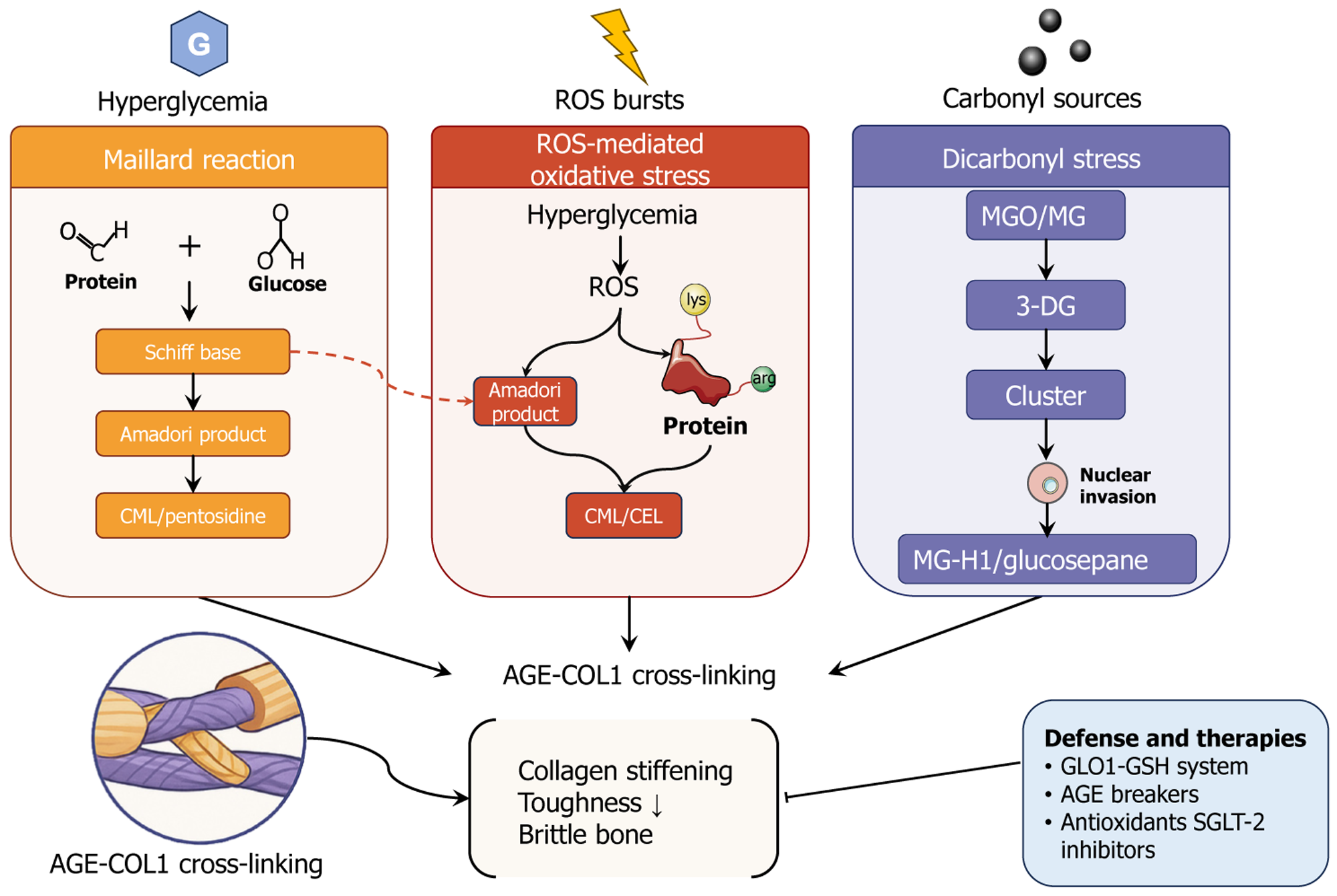
Figure 1 Hyperglycemia-induced biochemical routes to advanced glycation end product-type I collagen cross-linking and their skeletal consequences, together with representative defense strategies.
Persistent hyperglycemia initiates three chemically distinct yet convergent pathways that accelerate the accumulation of advanced glycation end products (AGEs) on type I collagen within bone: (1) Maillard reaction (orange panel): The non-enzymatic condensation of reducing sugars with protein carbonyl groups generates reversible Schiff bases, which rearrange into Amadori products and subsequently oxidize them into stable AGEs such as Nepsilon-(carboxymethyl)lysine and pentosidine; (2) Reactive oxygen species-mediated oxidative stress (red panel): Hyperglycemia-driven bursts of reactive oxygen species further oxidize Amadori products or directly modify lysine and arginine side-chains, yielding Nepsilon-(carboxymethyl)lysine and Nepsilon (carboxyethyl)lysine; and (3) Dicarbonyl stress (purple panel): Excess reactive carbonyl species (methylglyoxal, glyoxal) and their downstream 3-deoxyglucosone intermediates form intracellular clusters that can invade the nucleus and react with proteins to produce methylglyoxal-derived hydroimidazolone-1 and glucosepane cross-links. These three routes collectively intensify AGE-type I collagen crosslinking (lower left inset), which stiffens the collagen network, diminishes tissue toughness, and culminates in brittle bone (center). Endogenous and pharmacological counter-measures include the glyoxalase 1-glutathione detoxification system, chemical AGE breakers, antioxidants, and sodium-glucose cotransporter-2 inhibitors (lower right inset). CML: Nepsilon-(carboxymethyl)lysine; AGE: Advanced glycation end-product; COL1: Type I collagen; ROS: Reactive oxygen species; CEL: Nepsilon-(carboxyethyl)lysine; MGO: Methylglyoxal; MG: Glyoxal; 3-DG: 3-deoxyglucosone; MG-H1: Methylglyoxal-derived hydroimidazolone-1; GLO1: Glyoxalase 1; GSH: Glutathione; SGLT-2: Sodium-glucose cotran
- Citation: Li ZP, Luo C, Yu XM, Ye LY, Sun D, Duan CZ, Xu SY, Zeng MQ, Xu H, Peng ZY, Wang P, Wang YB, Ruan WJ, Xue ME, Zhang CJ, He DJ. Diabetic bone fragility through advanced glycation end product-collagen axis: Mechanisms and therapy of sodium glucose cotransporter 2 inhibitors. World J Diabetes 2025; 16(10): 111813
- URL: https://www.wjgnet.com/1948-9358/full/v16/i10/111813.htm
- DOI: https://dx.doi.org/10.4239/wjd.v16.i10.111813