
















©The Author(s) 2025.
World J Diabetes. Oct 15, 2025; 16(10): 109568
Published online Oct 15, 2025. doi: 10.4239/wjd.v16.i10.109568
Published online Oct 15, 2025. doi: 10.4239/wjd.v16.i10.109568
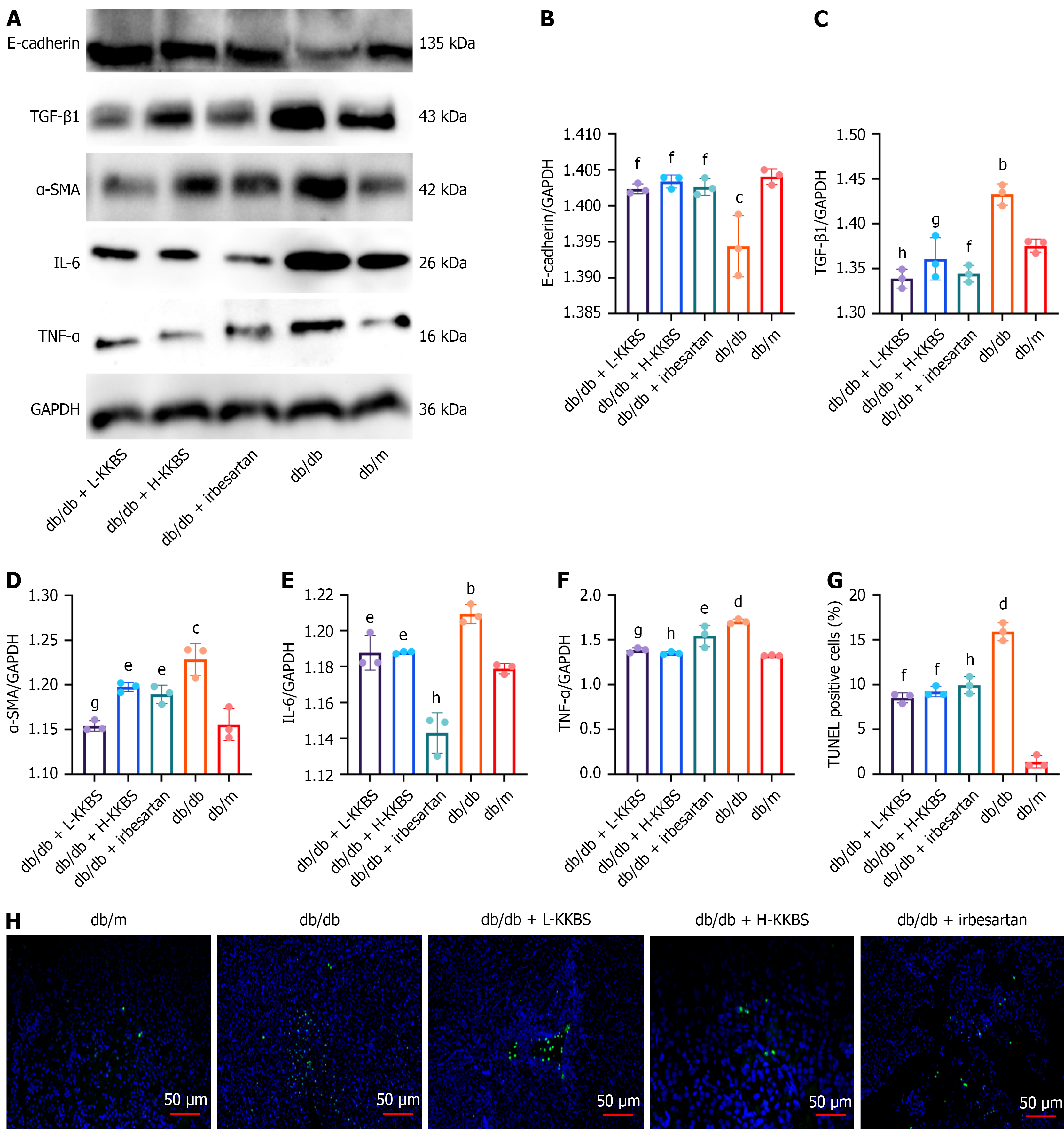
Figure 3 Kunkui Baoshen decoction alleviates inflammation, fibrosis, and cellular apoptosis in renal tissue of db/db mice.
A-G: Quantification of key inflammatory and fibrotic markers in renal tissues across five groups, including: Transforming growth factor-β1, interleukin-6, tumor necrosis factor-α, epithelial-cadherin, and α-smooth muscle actin; H: Assessment of renal tubular epithelial cell apoptosis using terminal deoxynucleotidyl transferase-mediated deoxyuridine triphosphate-nick end labelling staining. Representative images are shown for each group (scale bars = 50 μm). E-cadherin: Epithelial-cadherin; TGF-β1: Transforming growth factor-β1; α-SMA: α-smooth muscle actin; IL-6: Interleukin-6; TNF-α: Tumor necrosis factor-α; GAPDH: Glyceraldehyde 3-phosphate dehydrogenase; L-KKBS: Low-dose Kunkui Baoshen decoction; H-KKBS: High-dose Kunkui Baoshen decoction; TUNEL: Terminal deoxynucleotidyl transferase-mediated deoxyuridine triphosphate-nick end labelling. bP < 0.01 vs db/m group, cP < 0.001 vs db/m group, dP < 0.0001 vs db/m group; eP < 0.05 vs db/db group, fP < 0.01 vs db/db group, gP < 0.001 vs db/db group, and hP < 0.0001 vs db/db group.
- Citation: Song SY, Shan CC, Zhou PP, Xu WL, Tan Y, Zhou XQ, Huang LJ, Yan QH, Yu JY. Nephroprotective mechanism of Kunkui Baoshen decoction in diabetic kidney disease: Targeting the HERC2/NCOA4-mediated autophagy-dependent ferroptosis pathway. World J Diabetes 2025; 16(10): 109568
- URL: https://www.wjgnet.com/1948-9358/full/v16/i10/109568.htm
- DOI: https://dx.doi.org/10.4239/wjd.v16.i10.109568