
















©The Author(s) 2025.
World J Gastrointest Endosc. Nov 16, 2025; 17(11): 111770
Published online Nov 16, 2025. doi: 10.4253/wjge.v17.i11.111770
Published online Nov 16, 2025. doi: 10.4253/wjge.v17.i11.111770
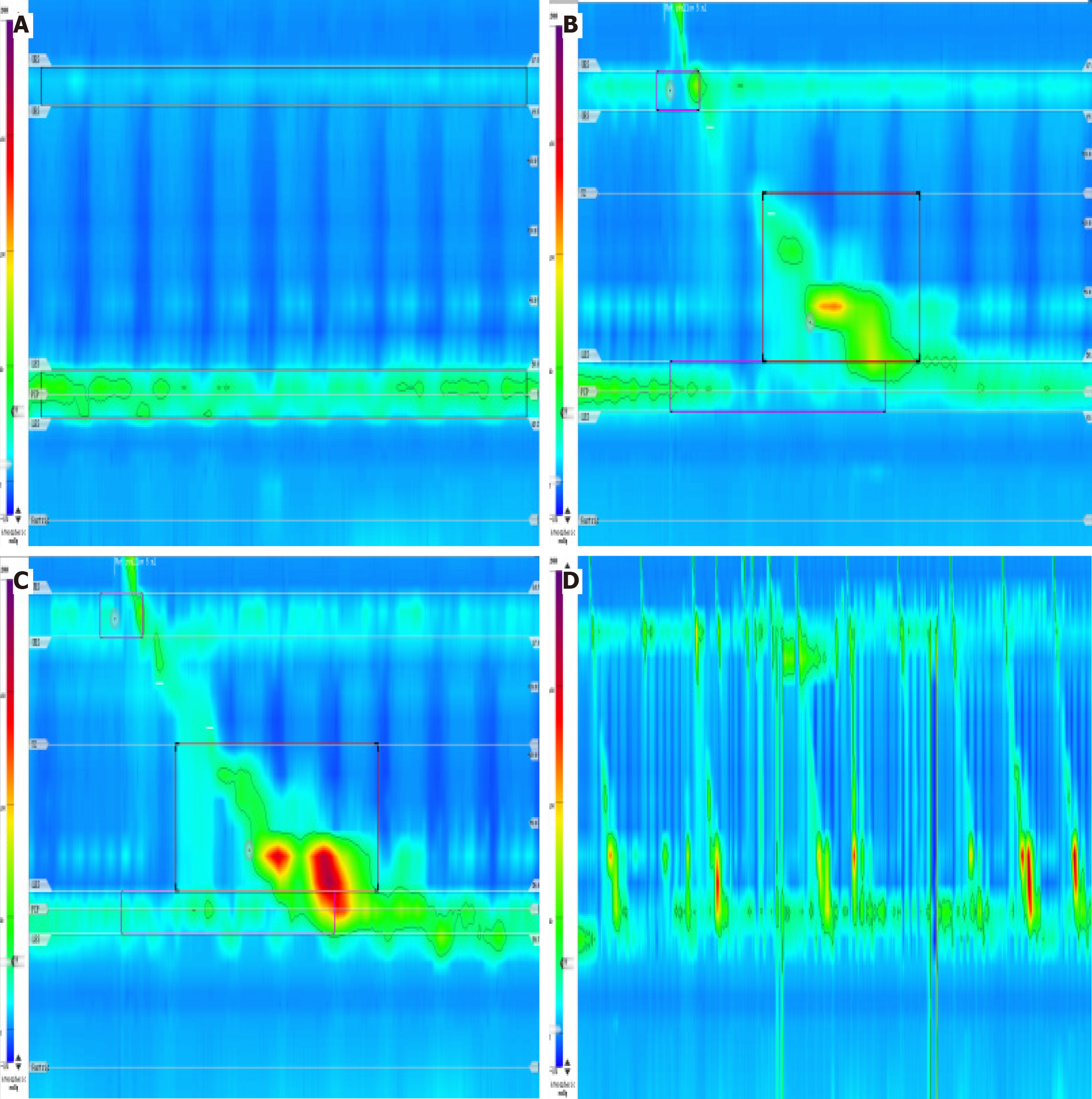
Figure 4 Esophageal manometry.
A: Static pressure: At rest, the upper esophageal sphincter pressure was low (8 mmHg in this patient, normal value 33-180 mmHg) and the low esophageal sphincter pressure was normal (27 mmHg in this patient, normal value 10-45 mmHg); B: 5 mL wet swallow: While normal 4s integrated relaxation pressure and normal distal contractile integral suggest normal peristalsis in the body of the esophagus, an interruption of the contraction wave on the 20 mmHg isobaric line with a defect length greater than 5 cm (6.5 cm) suggests segmental contraction; this swallow was ineffective; C: 5 mL wet pharynx: Normal 4s integrated relaxation pressure, normal distal contractile integral, distal latency, and maximal interruptions are in the normal range, suggesting normal esophageal motility; D: Comprehensive analysis: The patient performed 10 5-mL wet swallows, with 6 (60%) normal contractions (450 mmHg.s.cm < distal contractile integral < 8000 mmHg.s.cm) and 6 (60%) ineffective swallows (including 2 peristaltic failures, 2 weak contractions, and 2 fragmentary contractions). This suggests an indeterminate ineffective esophageal motility. Performed 3 multiple rapid swallows, with the distal contractile integral after performing multiple rapid swallows being less than the mean distal contractile integral of a single swallow, suggesting poor esophageal contractile reserve function.
- Citation: Liu XR, Chen XZ, Fan MW, Zhang SH, Shi N, Liu CX, Chen Y, Wang XM. Endoscopic treatment for dysphagia caused by mid-esophageal diverticulum and diffuse esophageal spasm: A case report. World J Gastrointest Endosc 2025; 17(11): 111770
- URL: https://www.wjgnet.com/1948-5190/full/v17/i11/111770.htm
- DOI: https://dx.doi.org/10.4253/wjge.v17.i11.111770